SELF CROSSLINKING ACRYLIC/
POLYURETHANE SEMI GLOSS AND ULTRA HIGH GLOSS
SEALERS
PENETRATING SEALER
SILANE MODIFIED FLUOROPOLYMER
IMPREGNATING SEALER
We are on the leading edge of
technology in high qulity - low v.o.c. products for your masonry, unglazed tile,
slate, pavers, concrete, marble, granite, grout, stamped concrete, limestone,
brick, clay, plaster and stone projects.
"... innovators in low v.o.c. stone protection
products..." "...Duro Shine develops and manufactures
high quality water-based products to the highest standards of performance...at
realistic prices..."
HOW TO SEAL STONE & TILE
GUIDE The following information is
provided to make your application of sealers trouble free. Often we find people
applying sealers as an after-thought. It should be understood that
applying sealers is as important a process as setting the tile.
HOME PAGE
PRODUCT MENU
PURCHASE PRODUCT
QUESTIONS
DEALER INQUIRES
I hope you find the following helpful. Read on, and happy sealing!
How to Seal Tile, Marble,
Granite, Fine Stones, Brick, Concrete, Slate, Grout, Clay, and Masonry with DURO SHINE SEALERS
part 1 - Our Products
part 2 - Technical information on defective
low v.o.c. lacquers
part 3 - Installation Information
First let's put our sealers
into four categories, and see the differences.
PENETRATING, ACRYLIC/ POLYURETHANE SILANE
MODIFIED FLUOROPOLYMER IMPREGNATING SEALER, AND THE COLOR ENHANCER
1) PENETRATING SEALER for use on concrete, clay, masonry
and pavers 404 Penetrating Sealer is listed
online by the Southern California Air Quality Management District as a
"SUPER COMPLIANT" product!
404 PENETRATING SEALER is
a penetrating sealer, as opposed to a film-former. A film-former is one
that forms a plastic film. These are nearly invisible. This sealer is a
potassium siliconate, and type of reactive silioxane. When it is applied,
it reacts with the concrete, forming densifying crystals, that add a water
resistant barrier.
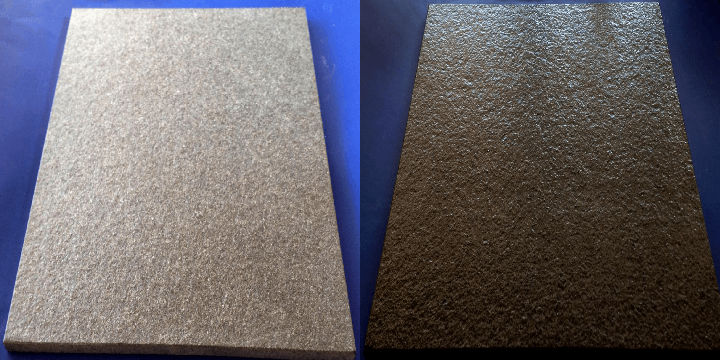
404 is for use on any masonry,
or clay type of porous tile, concrete or stucco. You would not use this
type of product on marble, or granite. This will protect against water,
and is an excellent grout release. A grout release means that if you install
a porous tile, such as a paver; you must stop the porosity of the tile
before you grout. If not, then the grout will stain the tile. 404
IS A STAND ALONE PRODUCT, and
should not be used in conjunction
with any other of our sealers.
404 is not intended to be an oil-resistant
product. Should oil fall on the surface; it will remain on the surface
for a time (days) at normal temperatures. But when you clean it up; oil
residual will remain in the upper layers of the finish.
404
is a great product for
the money. Most of the competitors require several coats to seal, and some
never quite do the job. Some if applied too much will get shiny; 404
will not. Some will turn to white powder on top; 404 will not. With
ours, you will only experience a slight color change of the surface. Not
really noticeable, unless you have a dark colored stucco and the color
must be precise.
404 is an off white, water
based liquid, that can be applied with a brush, roller or sponge. It can
be used with a sprayer.
But as always with sealers; test
some on an un-installed area before applying to your substrate.
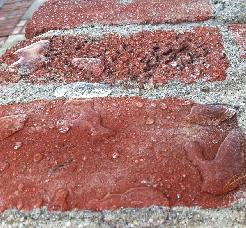
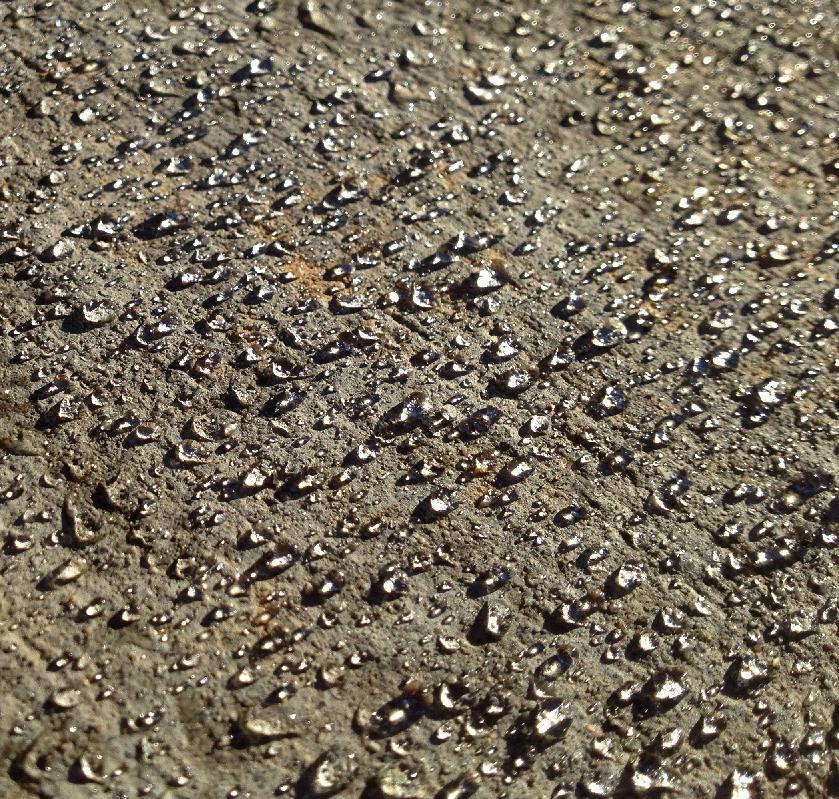
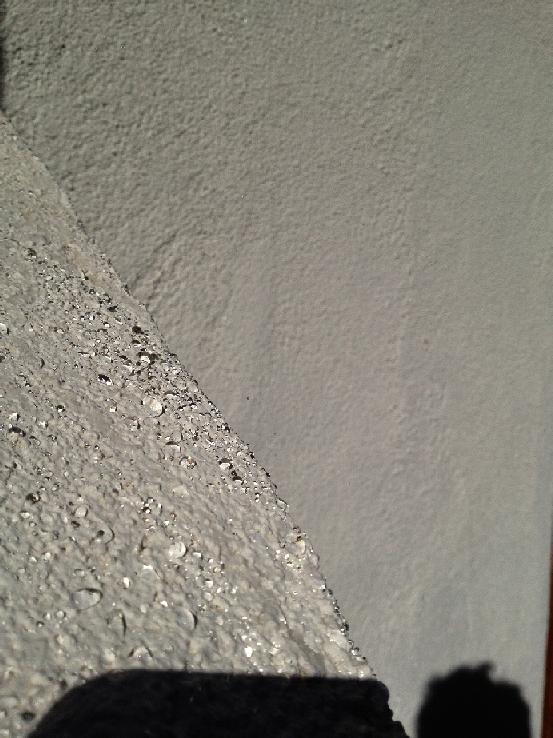
404 PENETRATING SEALER INFORMATION PAGE
CLICK BRICK TO ENLARGE
CLICK CONCRETE TO ENLARGE
CLICK STUCCO TO ENLARGE
2) Water
based SELF-CROSSLINKING Acrylic/ Poly Sealers for use on clay, concrete, masonry,
slate, pavers, bricks, decomposed granite,
sand joints and porous stones, but not travertine
Our water based Self-crosslinking
acrylic/ poly sealers are for use on porous surfaces such as concrete,
stone, clay and concrete pavers, brick, grout, stamped concrete, slate,
unglazed tile, decomposed granite, sand joints and masonry surfaces. These
are film forming sealers, are SUPERIOR
LACQUER REPLACEMENT
products. Film forming means they form a plastic film. These are
stand alone products. You start with them, and finish with them. They are
designed to be multiple coat products, because there needs to be a balance
between penetration, and coating. They penetrate very well on porous substrates,
so you
DO NOT use a penetrating sealer
first. Film forming sealers for tile, and stone need to
penetrate into the surface so they
are anchored in. If they just sit on the surface as a one coat product
would do, then vapor pressure could make them lift (delaminate), and you
would not get the depth of enhancement, or stain protection.
With the V.O.C. laws in California,
and other states following the same; water based products must replace
solvent based ones. In California, this change has happened. Dealers, and
contractors are looking for something to replace old, inferior
solvent basedlacquers. Our water based self-crosslinking
acrylic/polys out-perform any non-self-crosslinking product on the market.
We have two self-crosslinking acrylic/poly
products. 646 PLUS SEMI GLOSS, and 686ULTRAHIGH
GLOSS. As with the acrylics, the main difference is the look. 646
PLUS
is
semi gloss, and 686PLUS is the ultra
high gloss.
They are harder plastics than the
acrylics, and have a much higher melt point. When acrylics are softening
in hot weather; self-crosslinking acrylic/ polyurethanes maintain their
integrity. The self-crosslinking acrylic, and the solvent-free poly
are the ultimate resin for a film-forming sealer. The combination obtains
the optimum characteristics of each. The solvent free polyurethane side
adds to the hardness and durability. The self-crosslinking make these the
high end choice for use as a joint stabilizer, or binding decomposed granite.
These also add strength and integrity to grout.
When grout forms; it is similar
to concrete. It is a 28 day curing process. Most tile setters do not wait
more than a day, or two after grouting to seal tiles. Sealers damage the
grout curing process, and compromise the grout.
If someone tells you otherwise;
do the poor man's test to see what I am explaining.
Take a little grout in a small
cup, and mix it with the amount of water you would add to your grout. Then
take another cup, and instead of adding water; mix it with the same amount
of sealer. Wait a few days and look at your results. The water/ grout mixture
will be hardened, while the sealer/ grout will be like sand.
We recommend waiting until grout
is cured, and then get the extra added strength of our film forming sealers
on your project.
You also will not have to breathe
the high solvent content of lacquer, and at the same time...
get better results. Also if you look carefully at the label of
some solvent based
lacquer, some actually tell you not to
use where hydrostatic pressure (vapor pressure) exists. That would
be just about anything attached to the earth. Then they tell you to use
it on your driveway. Oil based lacquer is NON BREATHABLE. First it shines;
then it darkens and yellows as it decays, loosing the color, and essence
of the substrate, and peels. A common sales pitch we hear about
lacquer
is ..."it gives a beautiful dark look to the tiles".
Feel confident with our semi-gloss,
and ultra high gloss sealers. Our film formering sealers only slightly
darken the surface, while they enhance the natural colors, of your stone,
and are breathable. Breathable means that vapor pressure from below can
work it's way through the surface without delaminting it.
646 PLUS and 686PLUS
have
excellent coating and re-coat properties. Apply with a brush, sponge, roller,
or sprayer. Apply a heavy first coat, and let completely dry. Remaining
coats should be light. If the surface darkens like it is getting wet, when
you are applying; it is not sealed yet. When you apply the coat where it
does not darken when it gets wet; then it is sealed. The re-coat is excellent.
Do not apply in direct sunlight on a hot day. Flashing could occur, where
the sealer sets up on the surface, and does not penetrate into the surface.
646 PLUS LOW GLOSS INFORMATION PAGE
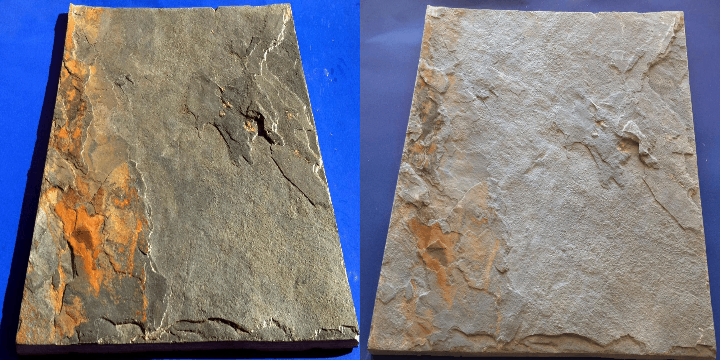
CLICK STONE 646 PLUS SEALED SLATE
CLICK STONE 646 PLUS SEALED PAVER
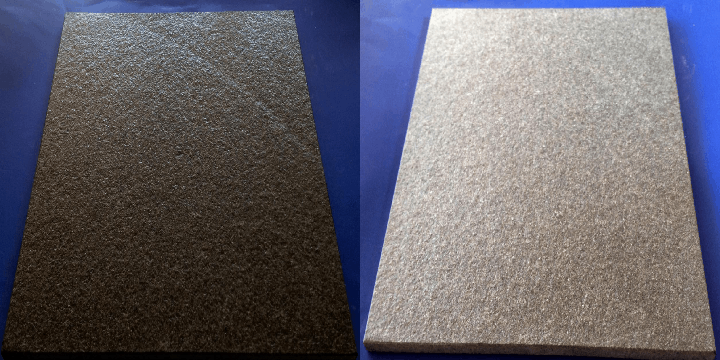
CLICK STONE 646 PLUS ON FLAMED GRANITE
686 PLUS ULTRA HIGH GLOSS INFORMATION PAGE
CLICK STONE 686 PLUS SEALED SLATE
CLICK STONE 686 PLUS SEALED PAVER
CLICK STONE 686 PLUS ON FLAMED GRANITE
3) Water Based Impregnating Sealer for use on marble, granite,
limestone, cantera, clay pavers plaster and concrete
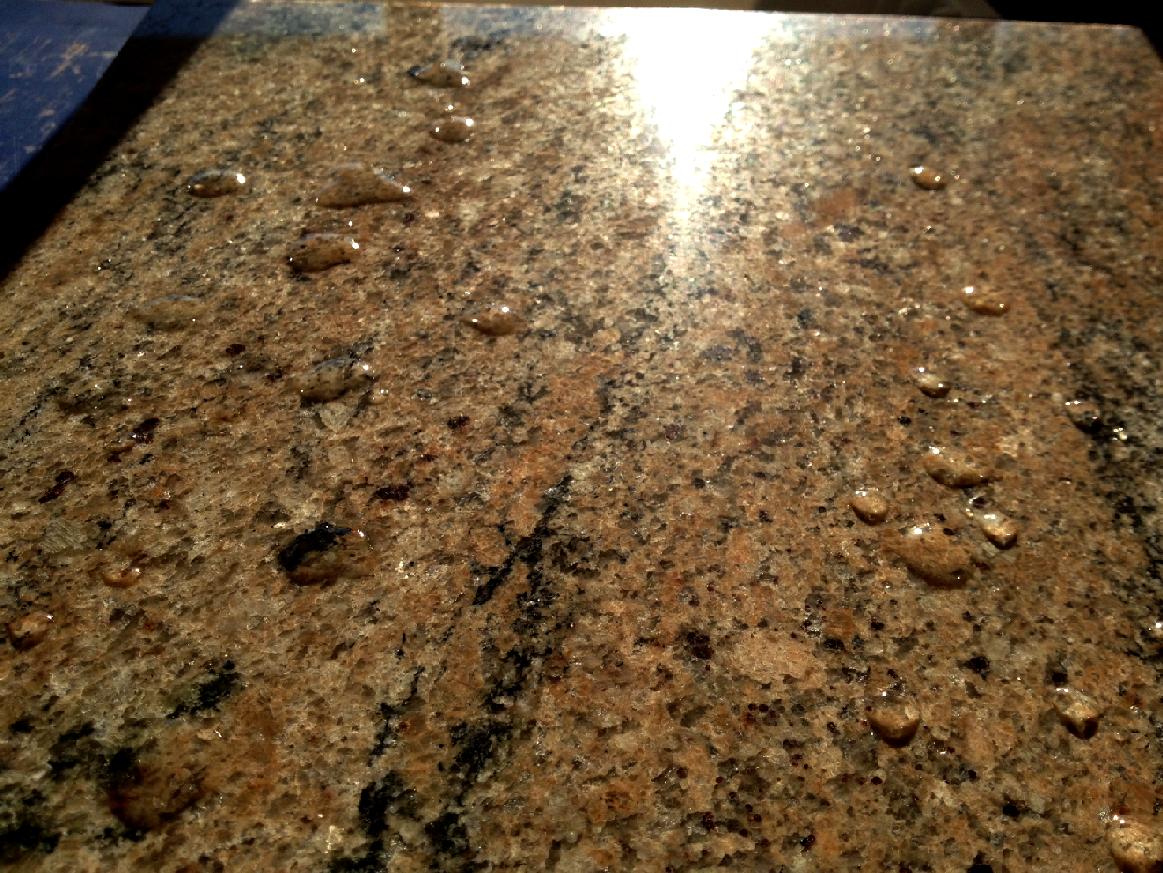
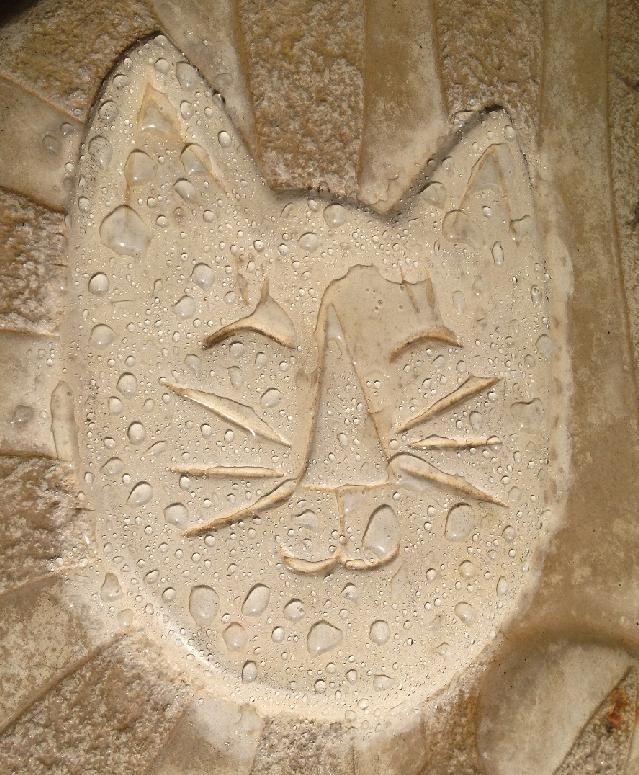
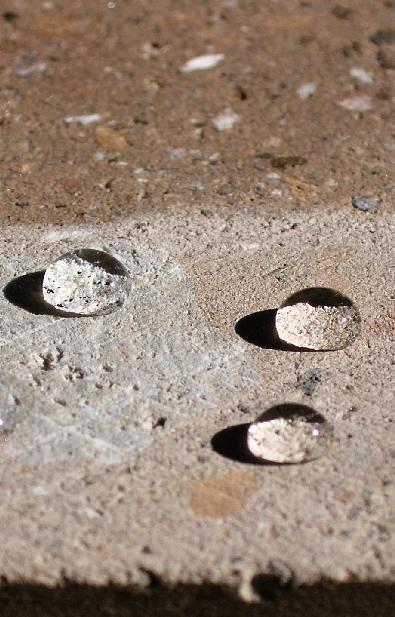
CONCRETE SEALED WITH INVISI-GUARD THEN WE DROP A BUCKET
OF WATER ON IT INVISI-GUARD is listed online
by the Southern California Air Quality Management District as a "SUPER COMPLIANT" product
!
Invisi-Guard Impregnator
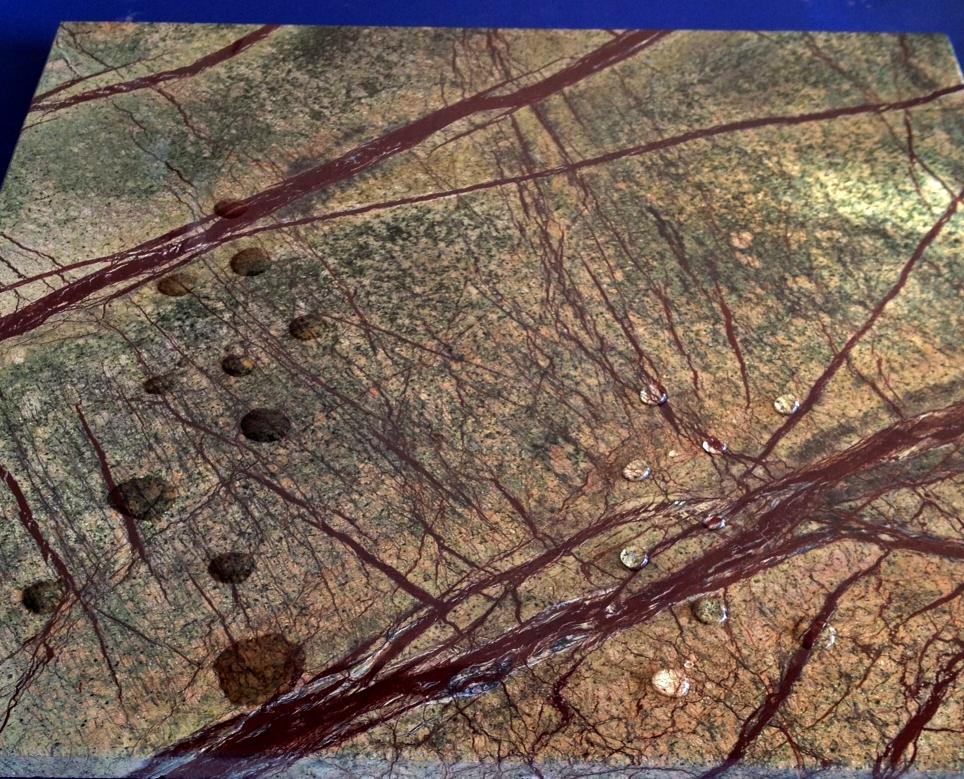
is a water based SILANE MODIFIED FLUOROPOLYMER, and the BEST impregnator
on the market. It is used on all types of stones to provide excellent water,
oil and stain resistance. It is nearly invisible. This is a water-based
product; 1.8 v.o.c. , and performs better than any oil, or water-based
impregnator on the market, including that impregnators are over 700 v.o.c..
We beat them at under 2 v.o.c..
This California proof of concept product is revolutionary.
Invisi-Guard is your choice
product for marble, granite, and other fine stones, that are not porous
enough for film-forming gloss, or semi-gloss sealers, as well as concrete,
and other porous stones, and plaster. It is a stand alone product, and
should not be used with any other sealing product. This is a reactive product,
that forms a permanent bond with the stone or masonry surface. Don't be
fooled by the price, or that it is water-based. Invisi-Guard proves
that near 0 v.o.c. can out perform sickening high solvent products.
Impregnators cost more than your
average film-forming sealer to make, but not 10 times as much. We refer
to what has evolved in the impregnator business, as the "Rolls Royce syndrome".
The first companies to come out with oil resistant, invisible technology,
set the mark at well over $100 per gallon. We manufacture the BEST product
at a reasonable price.
We are leaders in the latest, and
best low v.o.c. chemistry.
INVISI-GUARD INFORMATION PAGE
CLICK MABLE TO SEE ENLARGED
CLICK CANTERA TO SEE ENLARGED
CLICK GRANITE TO SEE ENLARGED
CLICK CAST CONCRETE ENLARGED
CLICK CANTERA TO SEE ENLARGED
HOME PAGE
PAGE AND PRODUCT MENU
PURCHASE PRODUCT
QUESTIONS
DEALER INQUIRES
INSTALLATION INFORMATION
#1 The surface
must be CLEAN, and DRY!!! before using any sealer!!!
This is the biggest way to get
in trouble. After surface is dry; allow enough time to assure surface is
stable and no discolorations, or salt typ deposits return to the area.
Sealers do not hide grout haze, efflouresence, or dirt. What you see is
what you get. Properly clean your surfaces before grouting. The surface
must also be visibly dry, so the sealer is absorbed into the substrate.
Failure to do so, may result in lifting, or peeling of the finish. This
is a golden rule for all sealers; not just ours. This is especially important
on floors where hydrostatic pressure may exist (vapor pressure from below
the surface). Even after a sealer cures in the upper part of a substrate,
vapor pressures will force their way up through the sealer. The particle
size of sealers usually leave small spaces approximately 1 micron, or smaller
which lets vapor pressure breathe out of the substrate. At the same time
standing water, and stains, on the surface will be repelled from absorbing
into the surface. If the surface is not dry when you apply the sealer;
capillary action does not draw the sealer into the surface. In this case,
the sealer will sit on the surface, and have nothing to grab into, and
the sealer will lift. This condition will appear similar to efflorescence.
This situation will require stripping the sealer and re-applying. So a
little patience, and preparation is well worth it.
#2
WATER, or OIL RESISTANT; do not mean WATER or OIL PROOF.
Look up the meaning of each,
and understand them. Resistant here means, these are great for an outside
patio that gets even a substantial amount of rain, or oil; but does NOT
infer that you would use these products to water-proof your water storage
tanks, or swimming pool, although they would provide a high degree of protection.
Also when a product is considered stain resistant; it still leaves the
burden of good house cleaning on the end user. Even if a sealer repels
a stain as it hits the surface; it will in many cases, loose some of it's
effectiveness as time goes on. Your sealer is designed to give you a jump
on stains.They are not intended for a replacement of good cleaning practices.
#3
If a floor has mortar, or efflorescence;
it must be cleaned, and dry before
applying sealer. If you need to use an acid to remove mortar, or grout
haze; use as weak a solution as necessary. Be sure to protect yourself,
as acids can cause serious burns. If an acid has been used; be sure to
read #8 (proper neautralizing), then rinse, and let dry. If you do not
neutralize after using acid, and then apply a sealer; the sealer will not
cure to it's maximum hardness. In the event of a strong solution of acid;
you could actually end up with your sealer having the hardness of a crayon.
This would only happen with a very strong solution, that was not neutralized.
Acid also breaks down concrete, clay and other types of masonry surfaces.
These surfaces are healthy in an environment, when the ph is above neutral.
Remember to properly pre-seal tiles to keep mortar, and grout from causing
a problem that would require using acid.
Do not attempt to hide efflorescence
with sealer. Efflorescence is that white chalky look that tiles, and concrete
sometimes get. It is most often an alkaline minerals such as sodium oxides
(inherent in clays, and mortars). These come to the surface with moisture
(vapor pressure), and react with carbon dioxide. They crystallize to form
chalky deposits. Use a ph neutral treatment to clean efflorescence, never
use an acid treatment. Again we rarely want to expose our surfaces to acids.
Be sure the surface is clean, dry,
and stable prior to sealing. Remember; what you see is what you get.
READ SECTION 9 HERE ON NEUTRALIZING
ACID!
#4
Whichever look you want; start with that product.
If you want an invisible look
then use either 404 Penetrating Sealer, or our Invisi-Guard Impregnating
Sealer, depending on the stone, and your requirements. If you want
a high gloss look, you should start, and finish with UltraHigh
Gloss 686 PLUS. For a matte, or semi-gloss look, use 646 PLUS SATIN/
LOW GLOSS. DO NOT USE A PENETRATING SEALER PRIOR TO A SEMI-GLOSS, OR
HIGH GLOSS PRODUCT. If someone tells you to do this; you are getting bad
advice.
Use product to pre-grout, and after
grouting, go back, and finish sealing with the product you started with.
Our products are designed with a good balance between coating, and penetration.
Some companies that produce water downed versions of sealers, tell you
to first use their penetrating sealers, and then use a film-former (plastic
sealer) on top. This flies in the face of good sense. Although there are
some circumstances where the substrate is so porous that you can apply
one coat of a penetrating sealer prior to an acrylic, or polyurethane;
good care must be taken by prior testing, to ensure that the film former
will properly absorbed into the surface. If you seal the surface too well,
the penetrating sealer will be a bond breaker between the surface, and
the sealer. Your safest bet is to start with the product you want as your
finish product. Whatever you do; never use a pre-grout product to clog
the pores that is not a sealer. Soap type products can work o.k. as a grout
release, but negatively affect the ability to properly seal the project.
#5
These are water based products.
Do not attempt to coat over an oil
based finish. It will not adhere. It will be obvious that the finish is
not taking. If you apply a water based product to an oil-based product,
you will see what is called cratering. That is when the sealer does not
lay down in an even coat and you see areas where the sealer is rejecting
itself from the surface. There are two things you can do in this circumstance.
One is to strip the old coating off, or if the law allows; you can re-apply
an oil based coating.
#6
The 646, 686 and 848 finishes can be removed
with any of the strippers on the market
for water based paint or sealers. The semi-gloss and high gloss are
acrylic modified and are stripped in the same manner as an acrylic. Bear
in mind, that strippers are products that melt plastic sealers.
Therefore use of chemical respirators,
good ventilation, protective clothing, and protective gloves are essential.
Read and follow all directions, and warnings provided by the manufacturer.
Avoid even short-term exposure to stripper fumes. We recommend you seek
professional help, if you are unsure about stripping your project. The
848 can also be removed with a stripper, but is more difficult.
Thats why we tell you to read all
instructions first, and test on un-instllaed piece.
#7
If you have not used a sealer
before on a given product; do
a test sample, on an un-installed piece of your stone, or tile, to ensure
it is the effect you are looking for, and that the sealer is compatible
with your substrate. Seal your test sample in the exact same manner you
plan to seal your substrate. Then after it is cured; test for water resistance,
stain resistance, slip resistance, and any other properties which you are
expecting the product to provide. Also if you are not sure about the suitability
of this product for your application; seek professional advice from a licensed
application company, and ask for references. You can also call us, and
we would be glad to assist you. And remember; these are maintenance products
that periodicaly
need to be re-applilied.
#8
People ask is this a one coat, or two coat product?
Our products are formulated to work
on a wide range of products. While they are designed to have very good
coating properties; there is no exact answer to how many coats. Different
stones have very differing absorption rates. Beware of so-called one-coat
products. You may not get proper penetration for the sealer to properly
work. Sealers are different from paints. Sealers need to absorb into the
substrate, and anchor in. You decide that your job is properly sealed as
follows:
Apply your first coat of sealer.
You see the surface darken as it gets wet. Let the surface become visibly
dry. Apply next coat. If the surface again darkens; it is not yet sealed.
When you apply the coat where the surface does not darken, as if it is
getting wet; then your job is sealed. We then recommend one more coat for
safe keeping. Remember to let the floor properly cure prior to expecting
full performance.
#9 Applying sealers after an
acid stain
If you are planning to use a film-forming
(semi-gloss, or high gloss product) over an acid stain; read this two times;
then read it again backwards! Acrylic,
and polyurethane sealers need to be in a ph range, slightly above neutral.
If they are not you will see a drop in performance. It will seriously affect
the hardness of the finish, and all other performance factors. The worst
case example
of acid contamination I have ever
seen was a job I looked at, that had 686 High Gloss applied. When I examined
the surface; it felt like crayon. I was not sure what was on the surface.
When the homeowner told me the other room was just fine; I inquired, and
found out that he had not used a sealer prior to grouting, and he had used
undiluted muriatic acid to clean the grout in this area. He also did not
rinse the surface. This did not just affect the sealer, but did some serious
damage to his grout.Your average person would not do something that radical,
but lesser degrees of acid contamination will affect the performance...To
demonstrate the importance of, and how to neutralize after acid staining;
I have quoted from the web site of the L. M. Scofield Company.
They manufacture acid stains, and
the following excerpt from TECH-DATA BULLETIN A-414 in italics shows
what needs to be done.
"....Rinsing: After the final
application of LITHOCHROME Chemstain Classic has remained on the surface
for a minimum of 4 hours, all unreacted Chemstain residue must be neutralized
and then removed completely prior to sealing. A solution of baking soda
(sodium bicarbonate) and water, using 1 pound of baking soda per 5 gallons
of water (454 g/19 L), can be used to neutralize the residual Chemstain
acid. The solution should be applied until it stops fizzing.
After neutralization, the
surface should be rinsed thoroughly with clean water several times to remove
soluble salts. Runoff may stain adjacent areas or harm plants. It should
be collected by wet-vacuuming or absorbing with an inert material. After
rinsing is complete, a pH test using litmus paper or pH paper should be
performed to verify that no residual acid is present. A wet strip of red
or neutral litmus paper should be applied to the surface, and if the litmus
turns blue, no residual acid is present. Alternatively, wide-range type
pH paper can be used by applying a wet strip to the surface and comparing
with the color chart. If the color chart indicates a pH of 7 or higher,
no residual acid is present. If residual acid is present, further neutralization
is required. After completion of neutralization, rinsing, and verification
that no acid is present, the stained surface should be tested for cleanliness
by wiping the surface with a white cloth. If residue appears on the cloth,
additional surface cleaning must be performed.
Failure to completely remove
all residue prior to sealing the surface will cause appearance defects, adhesion
loss or peeling, reduced durability, and possible bonding failure and delamination
of the sealer....Failure to completely remove all Chemstain residue and
rinse the surface clean prior to sealing will result in performance problems
with the sealer..."
TECHNICAL INFORMATION ON DEFECTIVE LOW V.O.C. LACQUER One of the most asked questions
that we get is regarding problems with lacquer that is re-formulated for
low v.o.c. compliance in areas like California. We hear many stories of
job failures, and disappointment with performance, yellowing, cracking
and peeling. Here is why LOW v.o.c. lacguer
is "defective, and out-dated!
Low v.o.c. means "low volatile
organic compounds", or ugly solvents that hurt the environment. Oil based
lacquer has always had it's short comings. It is a product of the 1960's,
and was the best solution of it's time.
The first problem with
all lacquer is that it's a non-breathable coating. If you read the can;
it most likely acknowledges "do not use in areas of hydrostatic pressure."
That would be any area where vapor pressure needs to come up from the ground,
or more clearly put...not for use on any area attached to the earth.
Now as states such as California
have found that better alternative products are available with much lower
v.o.c contents; State Air Quality Agencies have lowered the amount of v.o.c.
allowed in sealers. But companies that make lacquer...want to keep the
old dog alive in a low v.o.c. environment. But State Air Quality officials
are requiring new lower standards. Lacquer needs to be in a high v.o.c.
solution. Low v.o.c. lacquer is problematic. High quality, low v.o.c. products
can only be made with new, superior new technology.
The technical problem with low
v.o.c. lacquer is that the proper solvent for thinning this oil based
resin is Toluene. It is an oily solvent from the "aromatic" solvent family.
Unfortunately it is high v.o.c., and can not be used to it's proper levels
to comply with states such as California. In high v.o.c. lacquer; a small
amount of acetone is used to cause faster evaporation. Acetone is from
the "keytone" family of solvents. It is not a good solvent for lacquer,
but has it's place in the formula, (in small amounts) because it evaporates
better than toluene.
Acetone is considered an exempt
solvent in California. So the way manufacturers get the v.o.c. down to
acceptable levels is to replace the toluene with acetone. Again remember
that acetone is not a very compatible solvent for lacquer. So you have
two problems. One the evaporation rate of too much acetone causes rapid
evaporation. This causes several problems such as flashing, which is where
the sealer boils off on the surface, and does not get into the substrate.
So you get less protection, cracking, short life, and peeling occur. Secondly
since acetone is not a good solvent for lacquer; the formulation never
quite melds together properly. You do not get all the chemicals properly
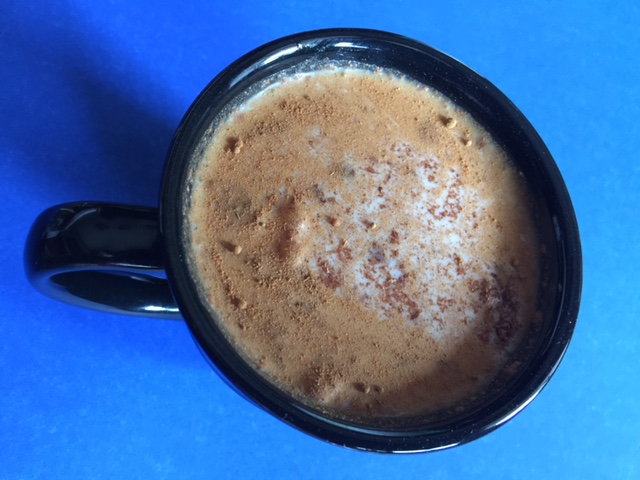
interacting with each other. Just picture making hot chocolate
with cinnamon, and the mix never quite blends in completely. You need a
new idea, not a re-formulation !
incompatible
what you deserve
So the next time you hear a manufacturer
say..."new and improved low v.o.c. lacquer formula"; remember...the words "defective",
out-dated and "unfixable".
Quality low v.o.c. products must
be made from resins that are designed to work in low v.o.c. environments.
This is why we only make gloss, and semi-gloss products from advanced self-crosslinking
acrylic/ polyurethanes.
Duro Shine Sealers LLC P.O. Box 5358 - North Hollywood,
Ca. 91616